

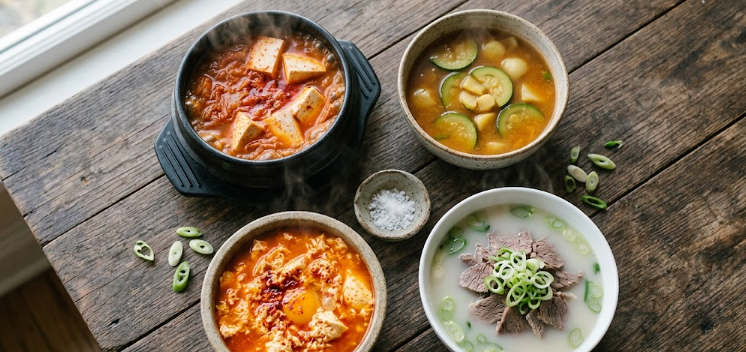
Quick Summary: Korean Soup Recipe
- Five Korean pantry ingredients power the flavor base for every major Korean soup recipe: doenjang, gochugaru, gochujang, fish sauce, and toasted sesame oil
- A 10-minute anchovy-kelp dashi is the broth foundation for kimchi jjigae, the doenjang jjigae recipe, and sundubu jjigae
- Sautéing kimchi or paste in oil before adding liquid is the single technique that separates a flat home-cooked Korean soup from the restaurant version
- This guide covers four Korean soup recipes, ranked by how much pantry you need: kimchi jjigae, doenjang jjigae, sundubu jjigae, and gomtang (Korean bone broth)
- Substitution notes are included for every Korean pantry ingredient, with a full path for readers without access to an Asian grocery store
The Five Ingredients That Let You Cook Korean Soup at Home Any Night of the Week
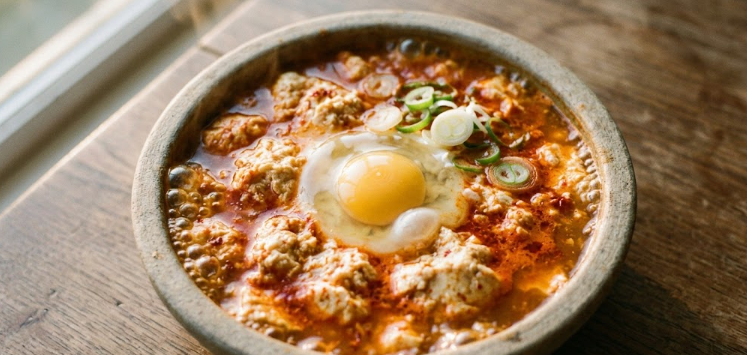
K-dramas have a specific soup moment. A stone bowl arrives at the table, red broth bubbling at the edges. Someone takes a spoonful and goes quiet in a way that tells you whatever they just ate was very good. The scene moves on and you are left wondering what was actually in that bowl.
A lot of home cooks first get interested in Korean cooking through a screen, not through a restaurant. You see the soup. You want to make it. You search for a Korean soup recipe and hit an ingredient list with three words you have never encountered, and you close the tab.
“With an angry red color, the stew looks aggressive and intimidating! However, the broth is surprisingly mellow, neither too spicy nor too salty.” — FutureDish
This Korean soup recipe guide explains what those ingredients are, what each one does, and how to get them. The soups that appear in K-dramas, kimchi jjigae, doenjang jjigae, sundubu jjigae are not technically difficult. The technique is shorter than making pasta. With five Korean pantry ingredients in the house, most of these soups take under 30 minutes from start to the table.
The Five Korean Pantry Ingredients That Do All the Heavy Lifting
These are not single-recipe purchases. Each one does a specific job across multiple Korean soup recipes. Buy them once and they last for months.
Doenjang (fermented soybean paste) Doenjang is Korea's fermented soybean paste, deeper and more pungent than Japanese miso. It is the base flavor for doenjang jjigae and acts as a seasoning layer in other Korean soups. It smells aggressive in the container. In the pot, it becomes savory and cohesive. Where to find it: Asian grocery stores or online. White miso works as a substitute — lighter in flavor and less complex, but the umami function holds.
Gochugaru (Korean chili flakes) Gochugaru gives a Korean soup recipe its color and a fruity, moderate heat that is different from cayenne or crushed red pepper. It is the primary spice in kimchi jjigae and sundubu jjigae. Where to find it: Asian grocery stores or online. There is no direct substitute. If gochugaru is unavailable, lean on gochujang as your heat source instead.
Gochujang (fermented chili paste) Gochujang is thick, sweet, and deeply fermented. It adds body and background heat and is now available at most mainstream grocery stores in the international sauces aisle. Where to find it: Most major grocery stores. A combination of sriracha and half a teaspoon of white miso approximates the function, without replicating the fermented depth.
Fish sauce Fish sauce adds salt and an oceanic background note that makes everything else in the pot taste more complete. It goes into most Korean soup recipes at the end, in a small quantity, as a final layer of depth. Where to find it: Most grocery stores. Soy sauce handles the salt function as a substitute but loses the oceanic note.
Toasted sesame oil Toasted sesame oil is a finish ingredient only. Add it off the heat at the very end of cooking. It loses its flavor and turns bitter if it sits in a hot pot. Where to find it: Most grocery stores. Skip it if unavailable rather than substitute regular sesame oil, which is a different product.
Once Korean soup recipes become part of a regular weeknight rotation, a ttukbaegi (Korean earthenware stone pot) earns its shelf space. It holds heat through the entire bowl, so the broth keeps simmering at the table rather than going cold between servings.
[Insert AAWP: Korean earthenware ttukbaegi stone pot]
The Broth That Makes the Korean Soup Recipe Work
Most Korean jjigae recipes call for water or generic chicken stock. That shortcut costs flavor. The base used in Korean home cooking is anchovy-kelp dashi, a 10-minute passive infusion that produces a clean, savory broth with built-in umami depth.
The dashi is what separates a Korean soup recipe that tastes like something is missing from one that tastes complete. Fermented pastes like doenjang and gochujang are built to work with this broth. In plain water, they sit on top of the liquid rather than integrating into it.
What anchovy-kelp dashi tastes like: Clean and oceanic, not fishy. The anchovy flavor cooks off during the simmer. What remains is a mineral, savory depth that makes fermented pastes cohere in the broth.
How to make it:
- Combine 4 cups cold water, 6 to 8 dried anchovies (heads and guts removed), and one 3-inch piece of dried kelp in a cold pot.
Skillet Frame Prompt [Close-up overhead shot, natural afternoon light from a kitchen window above a gas burner. A cold pot sits on an unlit burner. Pale water holds dried kelp — dark green, flat, slightly crinkled — and several dried anchovies, silver-gray and rigid, arranged loosely at the bottom. The water is completely clear. The kelp and anchovies are the center of the frame, raw and uncooked, identifiable against the light-colored pot interior. No packaging or labels visible anywhere in the scene.]
- Set the pot over medium heat. Bring to a low simmer. As soon as the water begins to move, remove the kelp. Leave the anchovies in.
Skillet Frame Prompt [Eye-level shot, natural kitchen light. A pot over medium heat at the first sign of a simmer, small bubbles forming at the edges, the liquid just beginning to move. Dried kelp is being lifted with metal tongs — dark green, slightly softened and more pliable than before, steam wisping around it. The anchovies remain in the pale golden liquid. The surface is calm, nowhere near boiling. The tongs and kelp are the center of the frame. No packaging or labels visible.]
- Simmer for 10 minutes. The liquid will turn pale gold and develop a clean, savory smell.
Skillet Frame Prompt [Close-up overhead, warm pendant light above a white stovetop. A pot holds pale golden dashi at a gentle simmer, small bubbles breaking slowly around the softened anchovies. The liquid is straw-yellow and mostly clear, steam rising in a thin column from the surface. The anchovies are slightly open, spent-looking but still intact. No packaging or labels visible.]
- Remove and discard the anchovies. The dashi is ready.
Skillet Frame Prompt [Eye-level close-up, overhead task lighting above a wooden counter. A small mesh strainer held over the pot. Softened gray anchovies rest in the strainer, the last of the liquid draining back into the pale gold dashi below. A ladle sits on the counter beside the pot. The strainer and its contents are the center of the frame. No packaging or labels visible.]
If you cannot find dried anchovies: Anchovy broth teabags are available online and dissolve directly into hot water. The result is close enough for any weeknight Korean soup recipe.
The dried anchovy and kelp pack is the one Korean pantry ingredient that most grocery stores do not carry. Ordering a supply online costs less than one restaurant bowl of Korean soup and lasts through months of weeknight cooking.
[Insert AAWP: Dried anchovy and kelp dashi pack]
The Technique Step That Makes or Breaks Every Jjigae
This is why home-cooked Korean soup often tastes thinner and less complex than the restaurant version. It has nothing to do with a missing Korean pantry ingredient.
Every Korean soup recipe that comes out flat did the same thing wrong: the kimchi or the paste went directly into liquid. It was simmered instead of cooked first.
Before any liquid goes into the pot, the kimchi or doenjang paste needs to go into hot oil and cook until it visibly changes. The change takes 4 to 5 minutes over medium heat. You are looking for two signals: a color shift and a smell shift. The kimchi deepens from bright red to a darker, more muted tone. The sharp fermented smell softens into something sweeter. That is a chemical change in the flavor compounds. Once it happens, the paste and the dashi become one flavor in the broth instead of competing with each other.
If you add liquid before this step, the broth stays thinner and more acidic. The fermented note never integrates. This is why two home cooks following the same Korean soup recipe can get noticeably different results from the same ingredients.
The step applies to all jjigae. Doenjang paste benefits from the same brief sauté before liquid is added. Sundubu jjigae starts the same way. It costs four minutes and it changes the entire bowl.
Four Korean Soup Recipes, Ranked by How Much Pantry You Need
All four soups below use the same anchovy-kelp dashi base. They diverge on one or two Korean pantry ingredients each. Start with the first and do not move to the second until the first one is automatic.
1. Kimchi Jjigae (Kimchi Stew)
Kimchi jjigae is the right first Korean soup recipe for most home cooks. The kimchi carries most of the flavor, so the technique demands are lower than in a soup where you are building depth from scratch.
From the five Korean pantry ingredients, you need gochugaru and toasted sesame oil. The kimchi provides the heat and the acid. Aged kimchi — fermented for several weeks — produces a deeper, more cohesive broth than fresh kimchi. If your grocery store carries only young commercial kimchi, a small splash of rice vinegar added to the broth compensates for some of the missing acid development.
Fatty pork belly is the traditional protein because the rendered fat enriches the broth as it cooks. Canned tuna is a genuine Korean weeknight option, not an approximation.
One broth note: rinse your rice twice before cooking and save the second rinse water. Use it in place of plain water in the dashi. The starch adds a light body that makes the Korean soup recipe feel more complete.
“I've made this recipe at least 10 times in the last 3 months.” — Korean Bapsang
Time: 30 minutes. [Internal link: Kimchi Jjigae Recipe]
2. Doenjang Jjigae (Fermented Soybean Paste Stew)
This is the second Korean soup recipe to add to your rotation. Doenjang jjigae is Korea's everyday comfort food, similar to miso soup in concept but more substantial and earthier, built around vegetables and tofu rather than a clear broth.
The doenjang is the feature ingredient, which means quality matters more in this Korean soup recipe than in kimchi jjigae. Smell the paste before buying: a good doenjang should smell deeply savory, not flat or watery. A thin doenjang produces a thin, underdeveloped Korean soup.
The vegetable combination is flexible. Zucchini, onion, mushrooms, and potato all work well. Korean radish adds a clean, slightly sweet note to the broth. If Korean radish is unavailable, potato covers the function and adds a mild starch thickness.
From the five Korean pantry ingredients, you need doenjang, fish sauce, and toasted sesame oil. Gochugaru is optional for heat.
The rice rinse water method applies here as well. It binds the doenjang to the dashi in a way that plain water does not.
“It turned out tasting like ramen, but better!” — Korean Bapsang
Time: 20 to 25 minutes. [Internal link: Doenjang Jjigae Recipe]
For doenjang jjigae and kimchi jjigae served directly at the table, a dolsot keeps the broth simmering through the entire bowl without needing to reheat between servings.
[Insert AAWP: Korean dolsot earthenware serving pot]
3. Sundubu Jjigae (Silken Tofu Stew)
Add sundubu jjigae once the first two Korean soup recipes are comfortable. This is the Korean soup that surprises most people who have only seen it listed on a menu. The broth is deeply spiced but not harsh. The tofu breaks into soft, silky pieces that become part of the broth's texture rather than sitting as separate chunks.
The key variable is the tofu: it must be silken, not firm. Silken tofu breaks down during cooking and adds a creamy consistency to the broth. Firm tofu holds its shape and produces a different Korean soup — not a failed one, but not sundubu jjigae.
From the five Korean pantry ingredients, you need gochugaru, gochujang, fish sauce, and sesame oil. Optional additions are clams, shrimp, or a raw egg cracked in during the final minute of cooking and left to barely set.
Time: 25 minutes. [Internal link: Sundubu Jjigae Recipe]
4. Gomtang (Korean Bone Broth Soup)
Gomtang is the longest Korean soup recipe in this guide. It is not the most technically demanding — it is the most time-dependent.
The flavor comes entirely from a long simmer of beef bones, oxtail or knuckle, which produces a milky, collagen-rich Korean bone broth. If you have made bone broth at home before, this is the same process with Korean seasoning applied at the end.
This is also a different kind of K-drama moment than jjigae. Gomtang shows up as the recovery meal, the Korean soup that someone brings when a person needs to be taken care of. The milky Korean bone broth, the clean simplicity, the sliced green onion on top.
The technique runs in two phases. The first boil lasts 10 minutes and gets discarded. It pulls the blood and impurities out of the bones and produces a cleaner final Korean bone broth. The second simmer runs 3 to 4 hours on the stovetop, or 90 minutes in a pressure cooker, until the broth turns opaque and the collagen is fully released.
From the five Korean pantry ingredients, you need fish sauce and sesame oil at the finish. The rest is beef bones, water, and time.
Time: 3 to 4 hours stovetop / 90 minutes pressure cooker. [Internal link: Gomtang Recipe]
Gomtang in an Instant Pot produces the same milky Korean bone broth as the stovetop version at a fraction of the time. The pressure cooker reaches the same collagen extraction in 90 minutes that the stovetop takes 3 to 4 hours to achieve.
[Insert AAWP: Instant Pot 6-quart]
How to Work Korean Soup Into a Real Weeknight Rotation
The home cooks who make Korean cooking stick are not the ones who try all four Korean soup recipes in the same week. They are the ones who cook kimchi jjigae four times in a month and then add a second soup.
Repetition matters here. The first time you follow a Korean soup recipe, you are reading the instructions. The second time, you are watching the pot. By the fourth time, the cook is as fast as any weeknight dinner you already know.
Batching the dashi: Make a double batch of anchovy-kelp dashi on the night you first cook jjigae. Use half for dinner. Store the rest in a sealed container in the fridge, where it keeps for five days, or freeze it for up to three months. The dashi is then already done the following week, and the prep time for any Korean soup recipe drops significantly.
Using leftovers: Kimchi jjigae left over from Monday works as the base for a rice bowl or noodle dish on Wednesday. Add cooked rice directly to the leftover Korean soup broth and heat through. The flavor typically deepens on the second day as the fermentation continues.
For readers without a Korean grocery store: Store-bought kimchi is available at most mainstream grocery stores and at Costco. Doenjang and gochugaru are available online, as are anchovy broth teabags. Gochujang is now carried at most major grocery stores. These four Korean pantry ingredients together are enough for kimchi jjigae and the doenjang jjigae recipe without a specialty store.
Dashi holds in the fridge for five days and in the freezer for three months. Stackable glass containers make the batch-and-freeze approach practical — one batch per week covers every Korean soup recipe you cook.
[Insert AAWP: Stackable glass meal prep containers]
Printable Pantry Starter Kit
Download the free Korean Soup Pantry Starter Kit: 10 Korean pantry ingredients, 6 Korean soup recipes, and a substitution chart for when your grocery store comes up short.
[Download the Pantry Starter Kit]
Start With One Soup
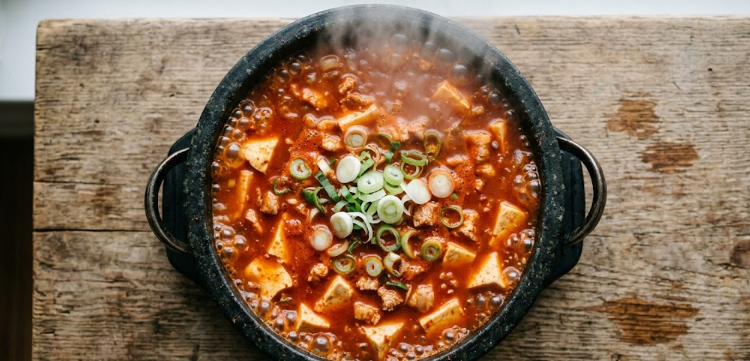
The K-drama soup that made you search in the first place was almost certainly kimchi jjigae or doenjang jjigae. Both are on this list. Both use the same broth base. Both are weeknight-fast once the Korean pantry ingredients are in the house.
You do not need all four Korean soup recipes to get started. You need one, cooked enough times that it stops requiring your full attention. After that, the second soup is just a matter of swapping one ingredient and keeping everything else the same.
The five Korean pantry ingredients in this guide cover the category. The anchovy-kelp dashi covers the broth. The caramelization step covers the technique. Cook the soup four times and it earns a permanent spot in the rotation — the same way any good weeknight dinner does.
“I've been cooking a lot of Korean dishes, this being one of the most usual. This recipe works really well.” — Korean Bapsang
If you want a reference sheet to keep in the kitchen, the Korean Soup Pantry Starter Kit has all five Korean pantry ingredients, six Korean soup recipes, and a substitution chart for the items that are harder to find. Download it below.
[Download the Korean Soup Pantry Starter Kit]
FAQ
Q: What is the difference between doenjang jjigae and kimchi jjigae?
Doenjang jjigae is a Korean soup recipe built around fermented soybean paste, with vegetables and tofu in an earthy, savory broth. Kimchi jjigae uses fermented kimchi as the primary flavor driver and produces a spicier, more acidic Korean soup. Both use the same anchovy-kelp dashi base; the paste or kimchi is what takes the broth in a different direction.
Q: Can I use miso paste instead of doenjang in a doenjang jjigae recipe?
White miso works as a substitute and produces a milder, less funky result. Use the same quantity the recipe calls for. The umami function is similar, but doenjang is aged longer and has a depth that white miso does not fully replicate. If you use miso, add a small amount of fish sauce to compensate for the missing layers.
Q: How long does homemade anchovy-kelp dashi keep?
Dashi keeps in the fridge for up to five days in a sealed container, or in the freezer for up to three months. Making a double batch on your first Korean soup recipe cook and freezing half means the broth is already done the following week.
Q: Why does my kimchi jjigae taste flat?
The most common cause is skipping the caramelization step. Kimchi needs 4 to 5 minutes of sautéing in oil before any liquid is added. If it goes directly into the dashi, the fermented note stays sharp rather than integrating into the Korean soup broth. The second common cause is young kimchi. Aged kimchi has more acid development and produces a deeper, more cohesive jjigae.
Q: Can I make a Korean soup recipe without going to a Korean grocery store?
Yes. Store-bought kimchi is available at most mainstream grocery stores and at Costco. Doenjang and gochugaru are available online, as are anchovy broth teabags. Gochujang is now at most major grocery stores. These Korean pantry ingredients together are enough for kimchi jjigae and the doenjang jjigae recipe without a specialty store run.
Q: Is Korean soup good for meal prep and freezing?
Kimchi jjigae and doenjang jjigae both improve on the second day as the flavors deepen and store well in the fridge for up to four days. Sundubu jjigae is best eaten fresh because the silken tofu breaks down further in storage. Korean bone broth (gomtang) freezes well for up to three months and is the best soup in this guide for batch cooking.
Q: What is the difference between jjigae and guk?
Jjigae is a thick, heavily seasoned stew typically served in a small stone pot at the center of the table, shared across the meal. Guk is a lighter Korean soup with a higher liquid-to-ingredient ratio, served as an individual bowl alongside other dishes. Most of the soups that appear in K-dramas are jjigae. Miyeok guk (seaweed soup) is a common example of guk.
Quick Poll
Is cooking Korean food because you watched a K-drama actually cultural appreciation?
A) Yes — trying to cook what you watch is one of the most genuine forms of respect B) No — it's trend tourism. You'll be on to something else when the next show drops. C) This question is just gatekeeping with better vocabulary
Why did you vote that way? Drop your take in the comments!