


Fast Facts: One-Pot Meals
- One-pot meals for large families work best when legumes, whole grains, and eggs anchor the dish
- Large-batch chili is one of the cheapest meals to feed a family of 5 or more, running $8 to $11 for 8 servings
- Pasta e fagioli feeds 8 for $6 to $9 using only pantry staples
- Rotisserie chicken and rice soup feeds 8 for $5 to $8 and uses leftovers already in the refrigerator
- Burrito bowls built from Sunday-cooked rice and black beans feed a family of 5 or more for under $10
- The lentil-blend method stretches 1 lb of ground beef to feed 8 people instead of 4
Feeding five or more people every night doesn't have to drain the grocery budget. It just requires a different approach.
One-pot meals for large families solve two problems at once: they cut cleanup down to a single vessel and they make it possible to cook cheap meals to feed a family of 5 or more without rebuilding the grocery budget from scratch. The cooks who've figured out how to get easy weeknight dinners on the table for under $15 aren't doing anything special. They're using multiplier ingredients, one Sunday cook session, and a few plate shifts that most families barely notice.
This guide covers all three.
The Ingredients That Carry Every Budget One-Pot Meal
Every cheap one-pot meal for large families runs on the same workhorses: legumes (beans, lentils, chickpeas), whole grains (rice, oats, barley, pasta), and eggs.
These aren't filler. They're protein and fiber sources that cost under $1 per serving and keep people genuinely full because of their fiber content, not just because of volume. Here's what each one costs at a baseline:
- Dried lentils: around $0.15 per cooked serving
- Dried black beans: 5 to 6 servings for under $1 per pound
- Long-grain white rice: about $0.12 per cooked cup
Most families already buy all three. The difference between a budget-challenged kitchen and a budget-efficient one is usually whether these ingredients anchor the one-pot meal or get pushed to the side.
“I get really sick of trying to think up a range of meals that everyone will eat, are reasonably healthy, not too expensive, and don't take three hours and eleven billion pots and pans.” — Mumsnet
That's the problem this system solves. Not just “what's for dinner” but how to stop reinventing the wheel every single night.
What Makes One-Pot Meals More Filling Without Spending More Money
High-fiber, high-protein ingredients are the answer: lentils, beans, whole grains, and eggs.
Fiber signals fullness more effectively than refined carbohydrates, and it holds for longer. A one-pot meal built on lentils and rice keeps a hungry teenager full for three to four hours in a way that a bowl of white pasta alone doesn't.
Adding a fat component reinforces satiety without adding significant cost. A tablespoon of olive oil, a small amount of cheese, or a drizzle of tahini rounds out the meal. Fat is a cost-effective tool in a large-family kitchen, not a line item to cut.

How to Stretch Ground Beef and Feed Twice as Many People
The most effective meat-stretching method for easy weeknight dinners is the blend.
For ground meat dishes like tacos, pasta sauce, chili, and stuffed peppers, a 50/50 blend of ground beef (or turkey) with cooked lentils is essentially undetectable by taste. A pound of ground beef that normally feeds four people now feeds eight. The lentils absorb the fat and seasonings from the meat and take on the same texture once cooked.
Here's how to do it:
- Cook 1 cup of dry brown or green lentils (yields about 2 cups cooked) and let them cool slightly
- Brown your ground beef until about halfway cooked
- Add the cooked lentils to the pan and break them up the same way you'd break up the meat
- Season the combined mixture exactly as you normally would
In taco meat, pasta sauce, or chili, the texture stays consistent and the flavor stays full. Cost per serving drops by approximately half, making this one of the cheapest meals to feed a family of 5 or more on a regular rotation.
For whole cuts, the stretch comes from format rather than blending. A whole roasted chicken feeds four as a main course, but shredded and spread across tacos, fried rice, or a casserole it feeds eight. The same $5 to $7 rotisserie chicken that covers Tuesday dinner has a second meal built into it. Shred everything, refrigerate the extra, and it becomes Thursday's filling for quesadillas, soup, or a quick one-pot meal.
The Sunday Grain Cook: Four Easy Weeknight Dinners From Two Pots
This is the single highest-leverage habit in large-family budget cooking.
On Sunday, cook one large pot of grain and one large pot of beans or lentils. A 3-cup dry batch of rice, farro, or barley yields about 8 to 9 cups cooked. A 1-pound bag of dried lentils yields about 6 to 7 cups cooked. Don't season them. Don't meal prep specific dishes. Just cook the raw material and refrigerate it.
Those two pots become the base for four easy weeknight dinners by changing the sauce and protein each night:
- Monday: rice, black beans, rotisserie chicken, and salsa — burrito bowls for 8
- Tuesday: rice, stir-fry sauce, frozen vegetables, and eggs — fried rice for 8
- Wednesday: lentils, canned tomatoes, onion, garlic, and cumin — lentil soup with bread for 8
- Thursday: rice, lentils, chicken broth, turmeric, and garlic — grain bowl or pot soup for 8
Total cost for those four one-pot meals runs $30 to $40 depending on protein choices. That works out to $1 to $1.25 per person per meal across four nights.
“It's not just that we have to cook — it's that we are reinventing the wheel each night.” — Medium
The Sunday cook ends that. Two pots on Sunday means four decisions already made before Monday starts.
One-Pot Meal Formulas That Feed 8 for Under $15
One-pot meals for large families work best when the format flexes around whatever protein is cheapest that week. Bean and rice dishes, lentil soups, pasta with blended meat sauce, grain bowls with eggs, and sheet pan dinners using bone-in chicken thighs all consistently deliver under $2 per person.
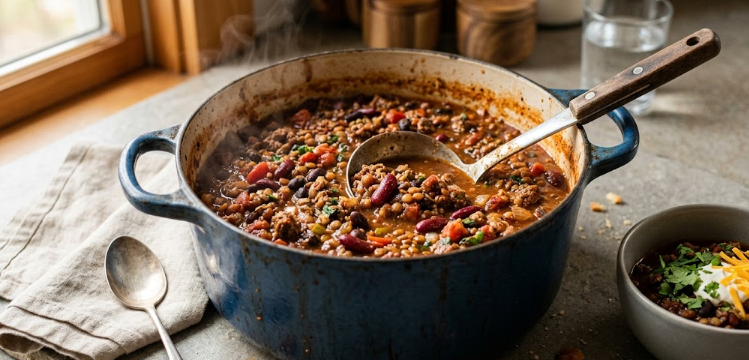
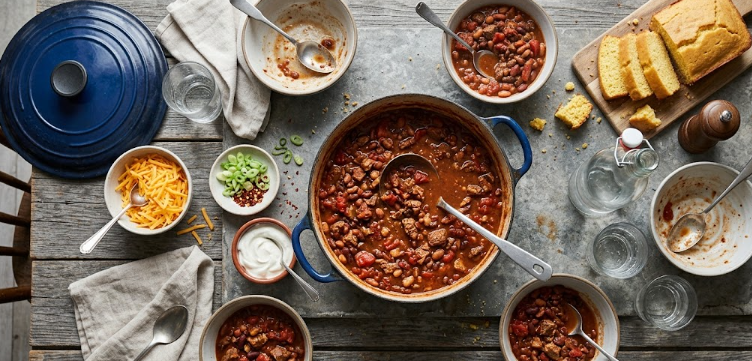
Large-batch chili is the most reliable crowd formula and one of the cheapest meals to feed a family of 5 or more in a single pot. Blend 1 lb ground beef with cooked lentils, add 2 cans of kidney beans, canned tomatoes, broth, and spices. The pot feeds eight for $8 to $11. The lentil blend disappears completely in chili, and the beans push the fiber content high enough that one bowl keeps people full for hours.
Pasta e fagioli is the fastest easy weeknight dinner for a large family at this price point. One pound of pasta, 2 cans of white beans, canned tomatoes, broth, and a Parmesan rind if you have one. That's $6 to $9 for eight servings. The starch from the pasta thickens the broth as it cooks, so the dish goes from soup to stew the longer it sits.
Rotisserie chicken and rice soup is the most budget-flexible one-pot meal of the three. Bones and leftover meat from one rotisserie chicken, plus rice, broth, onion, garlic, and whatever vegetables are already in the refrigerator. Cost runs $5 to $8 depending on what you pull from existing stock. If the refrigerator has half a bag of carrots and a couple of celery stalks going soft, this is the one-pot meal that uses them.
A large Dutch oven or 8-quart Instant Pot handles all of these in one vessel. The Instant Pot Duo 8-quart cuts lentil cook time from 25 minutes to 8 minutes and dried bean cook time from 90 minutes to 30 minutes, which matters on a Tuesday night when you're feeding a crowd. Disclosure: This page contains affiliate links. Purchases made through these links may earn a small commission at no additional cost to you.
How to Meal Plan on a Tight Budget for a Large Family
Start with your non-negotiables: the meals your family reliably eats without complaint. Write down 8 to 10 of them. That list is your rotation.
Look at which entries can become one-pot meals or use the lentil blend. For most families, at least half the rotation qualifies without changing the dishes enough for anyone to notice.
Once you've identified which meals stretch, build your shopping list around the cheapest protein for each meal that week:
- Chicken thighs on sale: three of that week's easy weeknight dinners use chicken thighs
- Ground beef on sale: the lentil-blend pasta sauce goes in that slot
- Dried beans on sale: stock up and freeze the cooked batch for the following week
You're not inventing new meals. You're directing your existing rotation toward what's cheapest at the store that week. The Sunday grain cook makes this actionable: shop once, cook two pots, and your one-pot meals for large families are 80 percent done before the week starts.
Budget Mistakes That Cost More Than You Think
These four habits quietly drain the grocery budget every week:
- Pre-seasoned proteins. Marinated chicken strips, pre-seasoned ground beef, and flavored sausages cost 30 to 50 percent more than plain equivalents and produce the same outcome when you season them at home. Buy plain, season yourself.
- Treating dried beans and grains as specialty items. A 5-pound bag of dried lentils lasts weeks and serves as the protein and fiber base for dozens of one-pot meals. If that bag isn't in your pantry, it's the first purchase to make.
- Underusing the freezer. Soup, chili, beans, grains, and casseroles all freeze well for up to 3 months. If Tuesday's lentil soup fed eight and four servings are left over, freeze them in individual containers. Those containers become emergency easy weeknight dinners that cost nothing.
- Shopping without a rotation. Going to the store without knowing what this week's meals are almost always results in a higher spend than planned, plus unused ingredients that expire before use. Ten minutes of rotation planning before the grocery run saves more money per week than any coupon strategy.
Get the Free Printable Grocery Card
Everything in this guide comes down to one shopping trip done right. The free printable grocery card has the full base pantry list, the Sunday grain cook quantities, and the four weeknight meal formulas laid out on a single page. Take it to the store, stick it on the refrigerator, or save it to your phone.
[DOWNLOAD THE FREE GROCERY CARD]
The System Is the Point
Cheap meals to feed a family of 5 or more don't require a different grocery store, a bigger budget, or an hour of prep every night. They require a rotation that's already decided, a pantry that's stocked with the right base ingredients, and one Sunday session that does most of the week's heavy lifting.
One-pot meals for large families work because they compress the effort. One vessel, one cleanup, one decision made in advance. The easy weeknight dinners that actually get cooked on a Tuesday night are never the ambitious ones. They're the ones that were already halfway done before the week started.
Start with the Sunday grain cook this week. Two pots, no seasoning, refrigerate and go. By Wednesday you'll have a system worth repeating.
Frequently Asked Questions
Q: Can I use canned beans instead of dried to save time? Yes, and they work in every one-pot meal here. A 15-oz can equals about 1.5 cups cooked and costs $1 to $1.50, compared to around $0.25 for the same amount dried. If you're cooking cheap meals to feed a family of 5 or more several nights a week, dried beans will save you meaningfully over time. Canned is a legitimate shortcut when time is short.
Q: What's the cheapest cut of chicken for large-family cooking? Bone-in, skin-on chicken thighs. They run $1.50 to $2.50 per pound, they're nearly impossible to overcook, and the fat in the skin adds flavor to whatever liquid they're cooked in. Boneless thighs cost more per pound and give you less flavor payoff in a one-pot meal built around a braise or soup.
Q: How do I keep lentil soup from tasting bland? Season in layers, not all at once at the end. Salt the onion and garlic as they cook. Add cumin, turmeric, or smoked paprika directly to the oil before adding any liquid so the spices bloom rather than dissolve. Finish with acid: a squeeze of lemon or a splash of red wine vinegar just before serving. That final acid hit is what makes the whole pot taste like something.
Q: Can I freeze the Sunday grain cook? Yes. Cooked rice and cooked lentils both freeze well for up to 3 months. Portion them into zip-top bags or containers in 2-cup increments so you can pull exactly what you need for a one-pot meal midweek. Thaw overnight in the refrigerator or reheat directly from frozen with a splash of water in the pan. Cooked farro and barley freeze the same way.
Q: My family won't eat lentils. How do I use the blend method without them noticing? Use brown or green lentils, not red. Red lentils dissolve and can change the texture of ground meat in a way some people notice. Brown and green lentils hold their shape slightly and match the texture of broken-up ground beef almost exactly. Start with a 25/75 lentil-to-beef ratio the first time, then move to 50/50 once the dish is accepted as one of your easy weeknight dinners.
Q: Is this approach gluten-free? Most of it is. Rice, lentils, beans, eggs, and chicken are all naturally gluten-free. Pasta e fagioli requires a swap to gluten-free pasta if that's a concern. Always check broth labels since some commercial broths contain gluten. Barley can be replaced with rice or quinoa in the Sunday grain cook.
Q: How long does the Sunday grain cook actually take? About 45 minutes of mostly hands-off time. White rice takes 18 minutes, brown rice takes 40, and dried lentils take 20 to 25 minutes on the stovetop. Both pots run simultaneously, and the active time (rinsing, measuring, getting pots on the stove) is under 10 minutes. That's a reasonable setup cost for cheap meals to feed a family of 5 or more across the whole week.
Poll
What actually counts as cooking dinner for your family?
- Making it from scratch, every component — otherwise it doesn't count
- Assembling real ingredients, even if some came from a shortcut
- Getting food on the table before everyone melts down — method is irrelevant
Why did you vote that way? Drop your take in the comments.