

Quick Summary: Feed A Family of 4 on a Budget
- What it is: A ready-to-use 7-dinner weekly rotation built for families of 4 on a tight grocery budget
- Who it's for: Families cooking on a budget who need the whole week solved, not just one recipe
- What you need: A short pantry staple list and one grocery run
- Time to implement: 20 minutes of planning, one shopping trip
- Bottom line: A fixed rotation is cheaper, faster, and less stressful than deciding what to cook every night
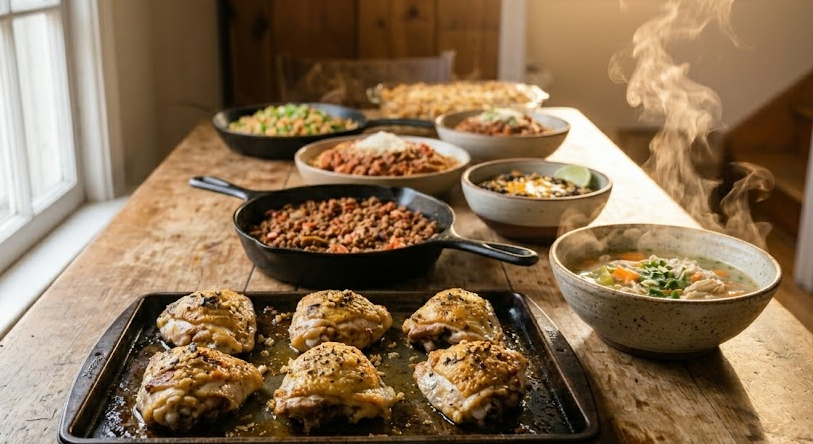
Somewhere around 5pm, the question hits. What's for dinner?
If you're trying to feed a family of 4 on a budget, that question carries more weight than it should. It's about money you don't want to waste on a grocery run you didn't plan, or takeout you can't really afford.
According to a Factor/Wakefield survey, 68% of Americans say deciding what to eat is their biggest mealtime challenge. That's the part that drains you before you've even turned on the stove.
This article gives you seven, one for every night of the week, with real estimated prices, a single grocery list, and a shopping strategy built to keep you feeding a family of 4 on a budget for roughly $50 on dinners alone. The USDA's current thrifty food plan puts the monthly dinner cost for a family of 4 on a budget at over $1,000. This rotation runs closer to $200 a month. The difference is the plan.
Why Deciding What to Cook Is Costing You Money
“It's not just that we have to cook, it's that we are reinventing the wheel each night.”
That line showed up in a Medium essay about weeknight cooking, and it captures exactly why budget cooking breaks down for most families trying to feed a family of 4 on a budget week after week.
When there's no plan, dinner becomes a last-minute decision. Last-minute decisions mean a mid-week grocery run for two or three ingredients you didn't have. Mid-week grocery runs mean buying at full price, grabbing extras you didn't intend to, and spending $30 when you went in for $8. Or you skip the run entirely and order takeout, which costs more than three of the dinners on this list combined.
The fix isn't cooking more. It's deciding less. Every family that figures out how to feed a family of 4 on a budget arrives at the same answer: a plan made before the hunger hits. A fixed weekly dinner rotation removes the decision entirely. You already know what's for dinner on Tuesday. You bought the ingredients on Sunday. There's nothing to figure out at 5pm.
Keeping your weekly rotation visible to the entire household on a magnetic refrigerator menu board is the easiest way to cement this habit, ensuring everyone knows exactly what's for dinner before the 5pm panic sets in.
How to Feed a Family of 4 on a Budget: The 7-Dinner Weekly Rotation (With Real Prices)
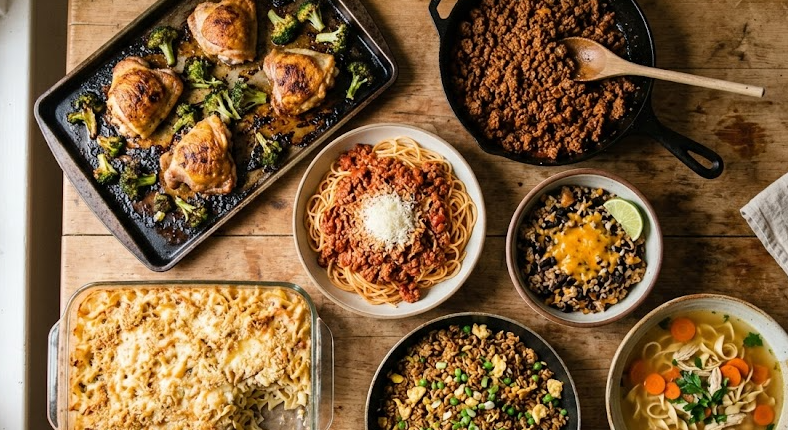
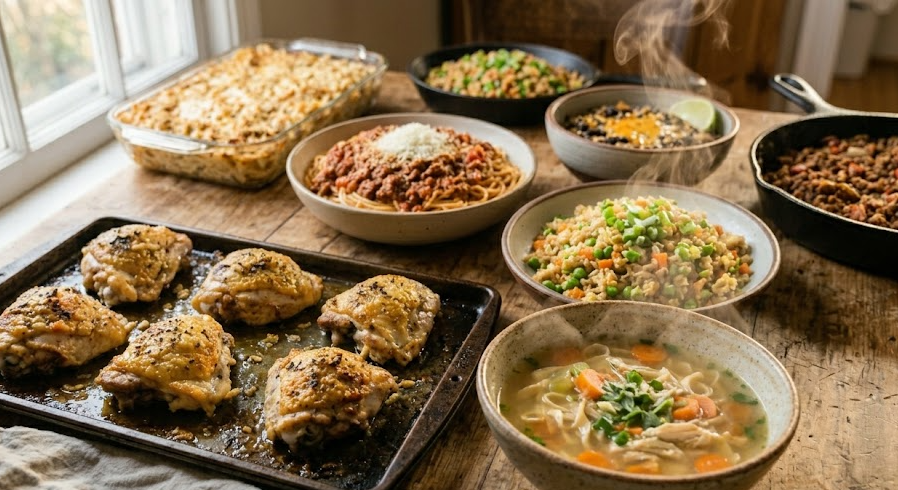
Every dinner here is built around cheap protein anchors: chicken thighs, ground beef, eggs, canned beans, and canned tuna, paired with cheap carb bases like rice, pasta, and potatoes.
Each one is designed to feed a family of 4 on a budget without requiring a specialty grocery run. Prices are estimates based on average US grocery costs as of 2026 and will vary by region and store.
Three of the seven dinners use ingredients carried over from earlier in the week. You're not cooking from scratch every night, and that's exactly the point.
Dinner 1: Sheet Pan Chicken Thighs with Rice (about $8)
Bone-in chicken thighs seasoned with garlic, soy sauce, and any dried spice you have on hand, roasted on a sheet pan alongside whatever vegetable is cheapest that week. Serve over rice. Cook extra rice and extra chicken because both carry forward to Dinners 4 and 6. This one dinner does the work of three, which is why it anchors this entire plan to feed a family of 4 on a budget. Active prep: 10 minutes.
To ensure your chicken thighs develop that perfectly crisp skin and your veggies roast evenly without sticking, a commercial-grade, warp-resistant aluminum half sheet pan is an essential tool for pulling off this anchor meal.

- Naturals bakeware is made of pure aluminum for superior heat conductivity and produces consistently...
- These premium pans are built for lifetime durability, ensuring they will never rust, providing you with...
Last update on 2026-10-14 / Affiliate links / Images from Amazon Product Advertising API
(As an Amazon Associate, we earn from qualifying purchases.)
Sheet pan chicken thighs live or die by the pan. A thin, dark, or warped pan steams the skin instead of crisping it, and you lose the browning that makes Dinner 1 worth building the rest of the week around.

- Naturals baking pans from pure uncoated aluminum which conducts heat rapidly and evenly, resulting in...
- Set includes our popular half sheet and a quarter sheet, great for roasting and baking.
Last update on 2026-10-14 / Affiliate links / Images from Amazon Product Advertising API
(As an Amazon Associate, we earn from qualifying purchases.)
Dinner 2: Ground Beef Tacos (about $9)
One pound of ground beef cooked with cumin, garlic powder, and a spoonful of canned chipotle in adobo stirred in at the end. Serve in flour tortillas with shredded cheese and whatever topping the family will actually eat. The chipotle costs about $2 for a can that lasts six meals. Feeding a family of 4 on a budget doesn't get much more straightforward than this. Active prep: 15 minutes.
Dinner 3: Pasta with Meat Sauce (about $7)
A box of pasta and a jar of marinara stretched with half a pound of ground beef or Italian sausage, a splash of pasta water, and a pinch of red pepper flakes. The pasta water turns a jar of sauce into something that coats every strand properly. This is one of the most reliable ways to feed a family of 4 on a budget because the base ingredients rarely cost more than $7 combined. Active prep: 10 minutes.
Dinner 4: Black Bean and Rice Bowls (about $5)
Leftover rice from Dinner 1, warmed in a skillet with a can of black beans, cumin, garlic powder, and a squeeze of lime if you have it. Top with shredded cheese and hot sauce. This is a full meal with no fresh grocery run required, and one of the cleanest examples of how to feed a family of 4 on a budget without cooking a second full meal. Active prep: 8 minutes.
Dinner 5: Tuna Noodle Casserole (about $6)
Two cans of tuna, a box of egg noodles, a can of cream of mushroom soup, frozen peas, and shredded cheddar baked until the top crisps. Every ingredient comes from the pantry or freezer. This is the dinner you make when you haven't had time to think about anything else, and it's one of the most pantry-efficient ways to feed a family of 4 on a budget in under 40 minutes total. Active prep: 10 minutes.
Baking a comforting casserole like this requires a deep, reliable baking pan that distributes heat evenly so the noodle edges get crisp without scorching the bottom of the dish.
No products found.
(As an Amazon Associate, we earn from qualifying purchases.)
Dinner 6: Egg Fried Rice (about $4)
Leftover rice from Dinner 1 or 4, fried in a hot skillet with two eggs, soy sauce, sesame oil if you have it, and whatever vegetable is in the fridge. Day-old rice fries better than fresh rice. This is the cheapest dinner on the list and one of the fastest. At $4 total, it's proof that feeding a family of 4 on a budget doesn't require sacrifice on flavor. Active prep: 10 minutes.
Egg fried rice only works in a properly hot pan. A thin skillet traps moisture and turns the rice soggy before it can develop any color. Carbon steel heats fast, holds heat, and gets better the more you use it.

- 1.5mm carbon steel gauge withstands high heat and maneauvers easily
- Regular seasoning brings out deep, beautiful patina
Last update on 2026-10-14 / Affiliate links / Images from Amazon Product Advertising API
(As an Amazon Associate, we earn from qualifying purchases.)
Dinner 7: Slow Cooker Chicken Soup (about $8)
Leftover chicken bones and any remaining meat from Dinner 1, covered with water in the slow cooker overnight or through the day, then strained and combined with diced carrots, celery, onion, and egg noodles for the last 30 minutes. The carcass does the work. If you want to feed a family of 4 on a budget without spending extra, this is the dinner that makes Monday's cook pay off twice. Active prep: 15 minutes.
For more slow cooker recipes, click here.
Letting the chicken carcass simmer hands-free is the ultimate budget hack, and a programmable 6-quart slow cooker ensures your broth safely develops rich flavor overnight or while you're at work.

- NOT YOUR MOM’S SLOW COOKER: Smart technology allows you to cook a recipe to either a desired cooking...
- PATENTED TEMPERATURE PROBE: Place the temperature probe into large cuts of meat to cook to a precise...
Last update on 2026-10-14 / Affiliate links / Images from Amazon Product Advertising API
(As an Amazon Associate, we earn from qualifying purchases.)
Dinner 7 is set-it-and-forget-it by design. The slow cooker does the work while you're not in the kitchen. If yours runs too hot, scorches at the edges, or doesn't have a programmable timer, the soup comes out wrong without you knowing why.

- 6-Quart capacity Fits a 6 lb. Roast and can serve 7+ people
- Easy to clean non-stick ceramic coating requires less effort to clean by hand compared with traditional...
Last update on 2026-10-14 / Affiliate links / Images from Amazon Product Advertising API
(As an Amazon Associate, we earn from qualifying purchases.)
Weekly dinner total: roughly $47 to $52 for a family of 4 on a budget.
How to Shop for This Rotation Without Going Over Budget
The reason this rotation stays cheap isn't just the recipes. It's that almost every ingredient on the grocery list works in at least two dinners. Chicken thighs show up in Dinner 1 and again as the base for Dinner 7. Rice from Dinner 1 becomes Dinners 4 and 6. Ground beef handles Dinners 2 and 3. You're not buying seven separate sets of ingredients. You're buying one overlapping set that covers the whole week. That's the structural advantage of trying to feed a family of 4 on a budget with a rotation rather than a random weekly meal selection.
“I get really sick of trying to think up a range of meals that everyone will eat, are reasonably healthy, not too expensive, and don't take three hours and eleven billion pots and pans,” one parent wrote on Mumsnet. The grocery list for this budget meal plan for your family fits on a single index card.
Here's what the full shopping list looks like:
- Proteins: bone-in chicken thighs (2 lbs), ground beef (1.5 lbs), canned tuna (2 cans), eggs (6 count)
- Pantry and dry goods: long-grain white rice (2 lb bag), pasta (2 boxes, one spaghetti and one egg noodle), canned black beans (1 can), canned cream of mushroom soup (1 can), canned chipotle in adobo (1 can), marinara jar (1 jar), soy sauce
- Produce and frozen: one cheap fresh vegetable for sheet pan night, carrots and celery for soup, frozen peas
- Dairy: shredded cheddar (1 bag)
The chipotle in adobo and soy sauce are pantry investments. Buy them once and they cover at least four to six future rotation cycles. They're not a weekly expense.
Anyone serious about feeding a family of 4 on a budget knows that the real savings happen at the list stage, not the checkout. If the grocery total comes in higher than expected, Dinner 4 and Dinner 6 are the two lowest-cost nights and both depend entirely on ingredients already in the house. They're built-in budget relief. Keeping a tight list is how you feed a family of 4 on a budget week after week without the total creeping up.
The Two Dinners You Don't Actually Have to Cook
Dinners 4 and 6 aren't really new cooks. They're the second half of work you already did on Monday.
Dinner 4 takes the leftover rice from Dinner 1 and turns it into black bean bowls. Dinner 6 takes that same rice, or whatever's left from Dinner 4, and fries it with eggs and soy sauce. Dinner 7 does the same thing with the chicken carcass and any remaining meat from Dinner 1, turned into soup in the slow cooker.
None of these feel like leftovers if you plate them differently. The rice that sat in a bowl on Monday becomes a skillet meal on Thursday. The chicken that came off a sheet pan on Monday becomes soup by the end of the week. “You need meals you can assemble rather than cook,” one home cook noted on AskMetaFilter. That's exactly what these three nights are. And for anyone trying to feed a family of 4 on a budget, assembling a meal from what's already cooked is the most efficient move in the rotation.
“I try too hard to do variety. I need to get better at cooking 2 for 1 meals,” one parent wrote on Glassdoor. This rotation builds that logic into the structure so you don't have to think about it. The overlap is already there. That's how you feed a family of 4 on a budget without cooking seven full meals from scratch every single week.
Since stretching your Monday leftovers into Thursday's and Friday's dinners is the core of this strategy, having a dedicated set of stackable, portioned containers makes storing and reheating these built-in meals effortless.
No products found.
(As an Amazon Associate, we earn from qualifying purchases.)
What to Do When Someone Won't Eat One of the Seven
Every rotation has one dinner the family pushes back on. It's usually the tuna casserole. Sometimes it's the bean bowls. The answer isn't to scrap the system. It's to build one flexible slot into the rotation from the start. Keeping that flexibility is part of what makes it possible to feed a family of 4 on a budget consistently over months, not just one good week.
Treat Dinner 5 as the wildcard. It's the slot that can swap without touching anything else on the list. If tuna noodle casserole gets rejected, replace it with any other cheap family dinner idea that uses ingredients already on the shopping list: a potato and egg skillet, a quesadilla night with the leftover cheese and beans, or a second pasta night with a different sauce. The swap works because the rest of the rotation stays intact.
For picky eaters, particularly younger kids, the easiest fix is to serve the components separately rather than combined. The taco meat, the cheese, and the tortillas on the same plate don't have to be assembled. The pasta and the sauce don't have to be mixed. Kids who refuse a combined dish will often eat each part on its own. It's the same dinner. It just arrives differently.
Families who want to keep feeding a family of 4 on a budget long-term need a system that survives one bad night. The wildcard slot is how this rotation does that. You don't rebuild the whole plan. You swap one dinner and move on.
How to Make Cheap Dinners Not Taste Cheap
The difference between a budget dinner that gets eaten without complaint and one that gets pushed around the plate usually comes down to one or two pantry additions that cost almost nothing per use.
Soy sauce on chicken thighs before roasting adds a salty, slightly caramelized depth that plain salt and pepper won't produce. A spoonful of canned chipotle in adobo stirred into ground beef gives the taco meat a smoky, slow-cooked quality that a seasoning packet can't replicate. A splash of pasta water emulsifies the marinara so it clings to the noodles instead of sitting in a puddle at the bottom of the bowl. These aren't specialty ingredients. Soy sauce runs about $2 a bottle. A can of chipotle in adobo costs $2 and covers six taco nights. Both fit easily into any plan to feed a family of 4 on a budget without inflating the weekly grocery total.
“I get really sick of trying to think up a range of meals that everyone will eat, are reasonably healthy, not too expensive, and don't take three hours and eleven billion pots and pans,” one parent wrote on Mumsnet. The pantry additions in this rotation don't add pots or prep time. They go into the same pan you're already using.
The other thing that makes cheap dinners taste better is heat. Most families who successfully feed a family of 4 on a budget long-term have figured this out: technique costs nothing. Chicken thighs roasted at 425°F develop a crisp, browned skin that thighs roasted at 350°F never will. Fried rice made in a properly hot pan gets a slight char on the grains that makes it taste like a restaurant order. Neither technique requires skill. Both require a hot pan and leaving the food alone long enough to develop color. That's the kind of detail that separates a budget meal people look forward to from one they just tolerate. It's also what makes feeding a family of 4 on a budget feel like a real decision rather than a fallback.
Get the Full 7-Dinner Rotation as a Free Printable
Everything in this article fits on one page. The 7-dinner weekly rotation, the complete grocery list, the estimated cost per dinner, and the secondary meal notes for Dinners 4, 6, and 7 are all laid out in a format you can print and stick on the fridge or tuck into your grocery bag.
No app. No account. Just a one-page reference that makes Sunday planning take ten minutes instead of thirty.
Download the free printable below and have the whole week handled before you leave the house.
Conclusion
The 5pm question doesn't have to be a problem you solve every night. When you know what's for dinner on Tuesday before Tuesday arrives, the decision is already made. The groceries are already bought. The money is already accounted for.
That's what this rotation does for anyone feeding a family of 4 on a budget. It moves the hard part, the deciding, to Sunday afternoon when you have ten minutes and a clear head. The cooking itself, once you're working from a list you trust, is manageable. Most of these dinners take 15 minutes of active work or less. Three of them barely count as cooking at all.
Write down the seven dinners. Shop for them once. Cook the first one tonight. The rest of the week is already handled. That is how you feed a family of 4 on a budget without burning out by Wednesday.
FAQ
Q: How do I feed a family of 4 on a budget if my kids won't eat half these meals?
Build the rotation around the two or three dinners your family already eats without complaint, then fill the remaining slots with close variations. Tacos become taco bowls. Pasta with meat sauce becomes pasta with butter and cheese for the kids, sauce for the adults. The budget stays intact when the base ingredients stay the same.
Q: What's a realistic weekly grocery budget for cheap family dinner ideas like these?
For dinners only, this rotation runs roughly $47 to $52 a week based on 2026 US average grocery prices. Total weekly spending including breakfasts and lunches typically lands between $100 and $130 for a family of 4 if you're applying the same ingredient-overlap logic to the rest of the day.
Q: Can I use this budget meal plan for my family if we don't eat meat?
Yes. Swap chicken thighs for a second can of beans or a block of firm tofu on sheet pan night. Replace the ground beef with lentils cooked with the same spices. The carb bases, the pantry staples, and the secondary meal structure all carry over without adjustment.
Q: How do I keep the rotation from feeling repetitive after a few weeks?
Change one pantry variable per dinner without changing the protein or the base. The chicken thighs that got soy sauce and garlic this week get smoked paprika and lemon next week. The taco meat that had chipotle this week gets green salsa next week. The dinner feels different. The grocery list doesn't change.
Q: What's the best way to store leftovers so the secondary meals actually work?
Cool cooked rice and chicken within two hours of cooking and store them in separate airtight containers in the fridge. Rice keeps for four days. Cooked chicken keeps for three to four days. If Dinner 7 won't happen within that window, freeze the chicken and bones the same night you cook Dinner 1.
Q: How do I feed a family of 4 on a budget when grocery prices keep going up?
The rotation structure is more resilient to price increases than one-off recipe cooking because you're buying in volume and using every ingredient across multiple meals. When a specific protein gets expensive, swap it out in the wildcard slot first. Chicken thighs have historically been one of the most price-stable cuts available.
Q: Is tuna noodle casserole actually cheap enough to be worth it, or are the ingredients adding up?
Two cans of tuna run about $2.50 total. A box of egg noodles is about $1.50. A can of cream of mushroom soup is about $1. Frozen peas and shredded cheddar add another $2 combined. The full casserole comes in around $6 to $7 for a family of 4, which makes it the second cheapest dinner on the list after egg fried rice.